Thursday, July 30, 2009

Darwin's rooms at Christ's College

Day Four
Thursday morning, July 9th

I visited Christ's College at the University of Cambridge to view the rooms where Charles Darwin stayed as a student. They have recently undergone an amazing restoration to their nineteenth-century appearance. (Click on the pictures to make them larger)

Christ's College, University of Cambridge


Post cards and a pamphlet on sale at the College


The College grounds

A list of the students and their rooms (as they existed in about 1828)


The restoration process of the room as it looked in early 2009,
in preparation for the bicentennial year


Darwin's room, photographed when I visited in July, 2009


A rather modest bedroom


The desk where Darwin looked over his collections


A much fancier living/dining room


A plaque on the wall


A view of the gardens


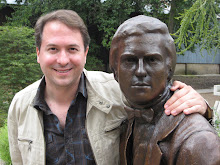
Earlier I posted a picture of myself with this newly created
bronze statue of a young Darwin the student on the grounds of Christ's.


My lovely fiancee Angie (now wife), posing with the statue


Some information about the connections between Darwin and Christ's


And good news for those who are interested in seeing some of the talks I've been been describing! From the Darwin Festival website:

"We have made recordings of all the day-time sessions and we also have over 24 hours worth of interviews with speakers and delegates. Once this has been edited, which may take some time, this resouce will be made available via the Festival website as well as a number of other channels.

We are also putting a Festival photo gallery together which will be accessible online soon."

I'll let you all know when the photos and videos are on the site!

Thursday, July 23, 2009

Universal Darwinism

Day Three
Wednesday afternoon, July 8th

After seeing the first half of Darwin on Stage and in Poetry, I headed over to the Universal Darwinism for part two of the session, which was mostly about memetics. It was sort of a pro and con view.


First up was Professor of Philosophy of Science Kim Sterelny, who holds professorships in both Australia and New Zealand speaking on 'Information Sharing and the Challenge of Novelty'. Sterelny's lecture was not only interesting and far-ranging, but also quite entertaining in his use of colourful language ("[attempts to model cognitive psychology] turn out to be f-ing hard!" "We can handle new risks and problems...like that sh*thole LAX!"). Regardless he had a lot of interesting things to say about how the human mind developed and the evolution of culture. He believes that the human "Information market" has a high profit/cost ratio, there was often a low risk of deception or defection in directly teaching new technologies and that an important element is social learning by doing, for example the apprentice to an early human stone shaper. I got the impression that his mind works much faster than his mouth can keep up, which lead to far too many "you know"s cropping up in his speech.


Next up was Professor and Director of the International Cognition and Culture Institute Dan Sperber from the Institut Jean Nicod in Paris. His talk was called Evolutionary approaches to culture: Three challenges and solutions, and put forth the overall position of Yes to Darwinism, but No to memetics. Much of his talk was developing his idea of Cognative Casual Chains, for example a meaning in someones mind leading to an utterance, leading to an interpretation in someone else's mind. I found his definition of imitation a little odd, Sperber believes that a person can imitate the sound of a word, but can not imitate the meaning, since it is not visible. Thus leading to his conclusion that the fidelity of cultural ideas is too low for culture to be Darwinian. He didn't seem to be a strong opponent to the usefulness of memes, but was just looking at the same questions from a different perspective. Dan Dennett (who obviously is a huge proponent of memetics) said afterwards that Sperber's position did not differ strongly from his own. As in many differences in philosophy, it seems to come down to slight differences in definition or meaning.

Next up: Day four brings The Shadow of Darwin in Humanity Today, a session of mostly evolutionary anthropology featuring Richard Wrangham and Chris Stringer among others.

Sunday, July 19, 2009

Punting on the Cam

A punt is a small wooden flat-bottomed boat that is used for navigating small rivers and shallow water. They are propelled by use of a long pole that is used to push off against the river bed. Navigating the river on one of these boats is called "punting", and there was no way I was visiting Cambridge without giving it a try!


"Punting is not as easy as it looks. As in rowing, you soon learn how to get along and handle the craft, but it takes long practice before you can do this with dignity and without getting the water all up your sleeve." – Jerome K. Jerome, Three Men in a Boat (1889)

The view under the bridges of Cambridge

King's College Chapel from the river Cam


I'd love to know who is reading this blog. It would be much appreciated if you could take a minute and add a comment (just click on the word "comments" below this post) to just tell me who you are and where you are reading this from. Thanks so much! -Greg

Friday, July 17, 2009

Darwin on Stage

Day Three
Wednesday afternoon, July 8th

This was quite a change of pace! Rather than focusing on the science, this session was all about theatre. Oxford lecturer and author Kirsten Shepherd-Barr did an excellent job examining the influence of Darwin in the world of Drama. She discussed this subject with two playwrights: Craig Baxter, who wrote the excellent "Re:Design", a dramatization of the correspondence between Charles Darwin and Harvard botanist Asa Gray, and Peter Parnell who wrote the play "Trumpery" about the effect of Alfred Russel Wallace's letter on Darwin. Joining them was Professor Stuart Firestein, a former dramatist turned neurobiologist, who had some interesting insights on both the theatre and science side of the equation. The main reason I was interested in this session was because I have an extensive background in theatre (I've been involved with acting for the past 28 years) and have even written my own Charles Darwin monologue, which I have performed over a dozen times around Vancouver (you can click on the links to see examples).

Craig's play "Re:Design" was commissioned by the Darwin Correspondence Project and he sifted through about 282 letters between Darwin and Gray to create his script. It was fascinating to me to hear how he had to search for a narrative thread in their correspondance, find the music and repeats in their relationship. Darwin's "voice" came very strongly to Craig while reading his letters, charming with self-deprecating humour, always questioning and cajoling Gray into helping him. The two men formed a life-long friendship and Asa Gray was Darwin's staunchest supporter in America. It was really neat to hear about the process that went into crafting this play, which I then attended the next evening (which I will cover in a future blog post).

I'm not sure what to say about Peter Parnell's (one of the producers of the TV show The West Wing) play "Trumpery" since I've never seen it, but wasn't very impressed with the description he gave us. It sounds like it plays too fast and loose with reality for my tastes, adding characters that didn't appear (Darwin's daughter Annie is a character, even though she had died four years earlier), combining historical figures (Lyell and Hooker) and condensing 7 years into two weekends. The Darwin in Parnell's play is driven by Oedipal guilt, worried that his theory is going to kill God/Father. His vomiting is a metaphor for Darwin's pent-up secrets. Wallace shows up to conduct a séance to contact Annie. I suppose I shouldn't judge it based just on the description, but well...

I was also happy to learn of other Darwin related plays out there: After Darwin (1998, Darwin and Fitzroy appear in a play within a play), Darwin Variations (2006) and This View of Life (2009, a one man show about Huxley).

I had to skip the second half of this session (Darwin in Poetry) so I could catch the second half of Universal Darwinism, which was a pro and con approach to using memetics to explain culture.

Thursday, July 16, 2009

Human Nature and Belief, Part 2

Day Three
Wednesday morning, July 8th

Continuing right after Dan Dennett's talk was one more main speaker, Oxford Professor John Hedley Brooke, President of the International Society for Science and Religion. His lecture was Darwinism and the Survival of Religion, dealing mainly with the History of Science and Religion in Victorian England. He began with a cute story of a sign on the front of a church in Jerusalem: "No Explanations in the Church". What this actually meant was tour guides were requested to be quiet when in the church, but he used it as a funny way of discussing the benefits of religion other than trying to explain the same things that science does.

Without a doubt the best quote of the talk was "Describing religion as a failed attempt to explain life is like calling ballet a botched attempt to run for the bus". Over all Prof. Brooke believes that nature leaves room for supernatural interpretation (which was in marked contrast to Dennett's air-guitar comment).

Next up were three panellists with shorter talks. Philip Kitcher, a Philosopher of Science from Columbia University, spoke on Religion and Human Nature: What Does Darwin Teach Us? In attempting to understand life as a series of historical processes, Prof. Kitcher suggested that perhaps religion originally began as an "Ethical Project", where an early human tribe decided on a set of useful rules that could assist "human compliance in the norms of a group". To my ear, he seemed to be suggesting that human behaviour was all "culture", and thus there was no need for a "biological explanation". Hmmm...

Robert Richards is from the University of Chicago (you could tell from his black t-shirt, black leather jacket and very thick midwestern accent) where he is a Professor in the Departments of History, Philosophy and Psychology. He threw out a wall of rapid words that mostly flew right over my head. There was something about "adopting the language of final causality" and a "moral sense that can be an advantage to the bearer", but that's as much as I was able to capture. In my notes I wrote "lots of words, not sure the meaning of most".

Steve Jones, Professor of Genetics and head of the Biology Department at University College London, was a familiar name to me because I really enjoyed his book Darwin's Ghost: The Origin of Species Updated (also known as Almost Like a Whale). Prof. Jones was quite witty and tossed off many seemingly practiced bon mots. My favorite was when he was asked to speak at Saint Paul's Cathedral on the subject of "Why are we here?" and began with "I don't know why we are here, but I know why I am here - you couldn't get Richard Dawkins". I was rather disappointed with his talk since he mostly trashed sociobiology, saying that only in the most general terms can evolution be useful in explaining culture. He also felt that evolution was bad at explaining how we became human since all of the traits that define us are unique. I guess he's not too up on comparative primatology and doesn't know any good cultural or physical anthropologists.

Given that most of these speakers were either pro-religion or anti-sociobiology/memetics, it seemed like a bit of a set up against Dan Dennett. This became painfully obvious when Professor of Divinity, Sarah Coakley, the chair (and presumably organizer) of the session, kept making snide little asides to Dennett: "Meme's might be all made up" and later "You can't see memes either". So much for impartiality of a moderator.

The best thing to come out of the session (besides of course Dan Dennett's much applauded, rousing talk) was when during the Q&A the panel was asked why biology seems so obsessed with Charles Darwin. Steve Jones put it beautifully when he said that the science was worth obsessing over for it's own sake, but Darwin is worth praising for being such "a nice scientist" which is rather rare, but also for being the best biologist to have lived.

Wednesday, July 15, 2009

Dan Dennett Lecture

Dan Dennett makes a philosophical point.


He has a slightly different view of creation.


Also a slightly different version of The Ascent of Man.

Human Nature and Belief, Part 1


Day Three
Wednesday morning, July 8th

What a great way to start my birthday! The morning session was started by Daniel Dennett, philosopher at Tufts University and author of Darwin's Dangerous Idea, Freedom Evolves, and Breaking the Spell. Dan also has been one of my favorite thinkers and writers ever since I was a grad student at Stonybrook University and George Williams passed on his advanced review copy of Darwin's Dangerous Idea.

I've seen Dan speak three times now, and I think this was my favorite of the bunch. When I ran into Dan on the first day of the festival, I asked him if I could have a picture taken with him . He graciously posed with me (see above) then commented, "I bet you didn't expect Darwin himself to be here." He must have thought that was the only reason I was asking for a picture, but I assured him that I knew who he was, and it was Dennett I wanted a picture with, not Darwin.

Dan's talk was entitled Darwin and the Evolution of Why: The Evolution of Reasons. He began by talking about the pre-Darwin "trickle-down theory of creation" and the replacement with Darwin's "bubble-up theory" which was in the words of a Darwin critic a "strange inversion of reasoning", where understanding is actually the effect, not the cause.

He gave some really cool examples of natural artifacts that show this inversion: Difflugia coronata is an amoeba that builds a beautiful shell out of sand; also the caddisfly larva that builds an ingenious food sieve that looks just like a human-made lobster trap; and the behaviour of a cuckoo chick that pushes out the nest the true offspring of its adoptive parents: "competence without comprehension".

He went on to discuss viruses ("nucleic acid with attitude"), glossogenetic trees of language, and Richard Dawkins' theory of memes. He concluded that we humans are the "first intelligent designers in the tree of life". Originally God was supposed to have created everything, but ever since Darwin's theory of natural selection, there has been less and less need for the direct role of a god in actual creation. According to Dan, since God's role has continually been diminished, all that is left is "a God that plays air guitar...and that's lame".

Some other choice quotes that came up during the question and answer period: "religion can gracefully retreat from science". When asked about religion's freedom to "make things up", Dan replied "it makes things up...and also makes them down". He also compared theologians to Lewis Carroll's Cheshire Cat, when their reasons and explanations keep disappearing, all that is finally left "is a comforting smile".